


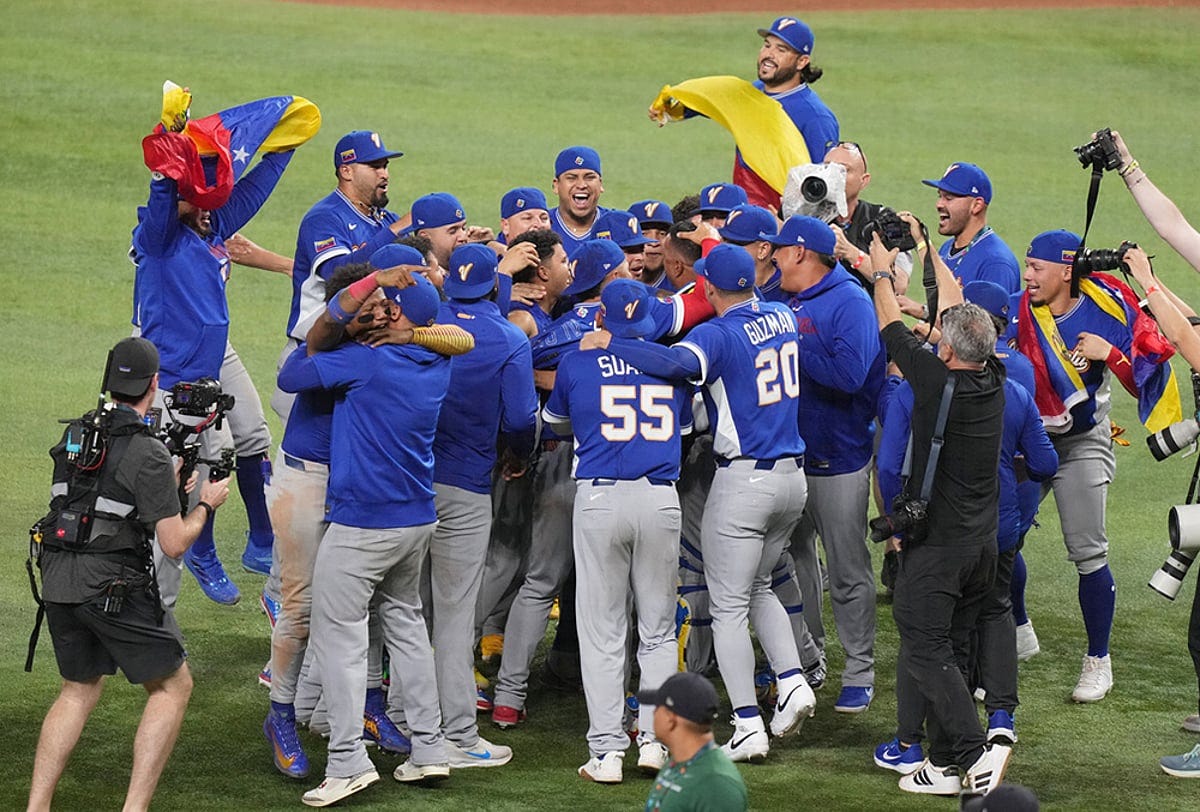
Let's start with this image: Eugenio Suárez, on his knees in the grass at loanDepot Park, head thrown back, arms outstretched, soaking in the noise of 36,000 screaming Venezuelan fans. Tears on his face. His teammates sprinted toward him from every corner of the diamond. His manager was screaming "long live Venezuela" into the air.
Now contrast that with Team USA. Three hits. Zero at-bats with a runner in scoring position through the first seven innings against a pitcher with a 5.02 ERA. Aaron Judge, the captain, is going 0-for-4 with three strikeouts in the biggest game of the tournament. And through all of it, silence. Not the silence of devastation. The silence of guys who were already thinking about spring training.
The United States had the most talented roster in World Baseball Classic history. They also had the least heart.
I hate to be the one to say it, but this United States team had no passion for their country.
The Scoreboard Said More Than the Stars Did
Before we talk culture and attitude, let's look at the numbers, because the lack of passion showed up in cold, hard statistics.
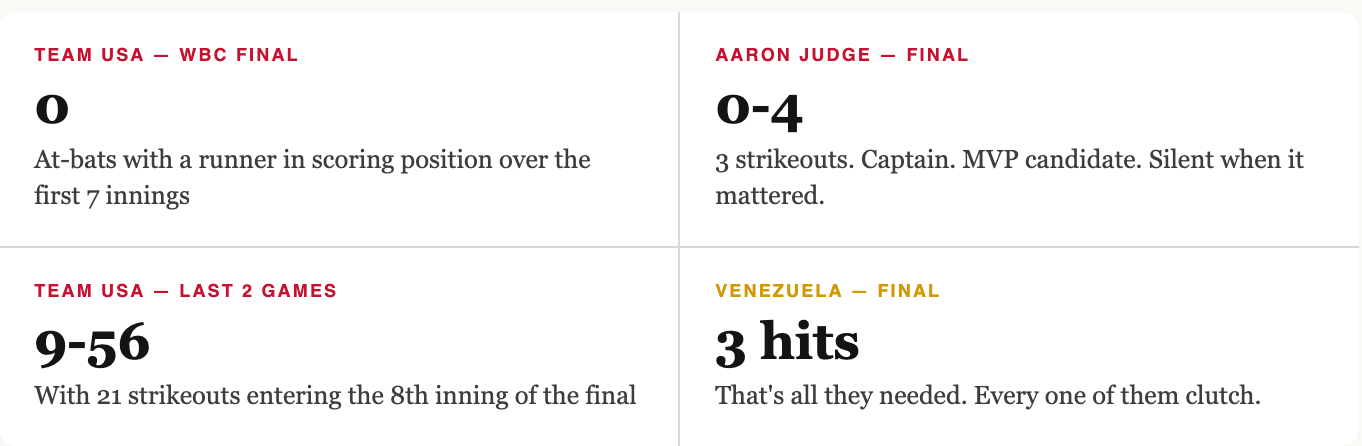
This is a lineup that features Aaron Judge, Bryce Harper, Bobby Witt Jr., and Kyle Schwarber, generational talents who the sport markets as its biggest stars. They were held to three hits total by a pitcher who struggled badly last season and a Venezuelan bullpen working on back-to-back nights. Eduardo Rodríguez shut them out over 4⅓ innings and exited with one hit allowed. The Venezuelan bullpen, exhausted after needing 23 outs from relievers against Italy the night before, covered the rest without breaking.
The only life Team USA showed was a Bryce Harper two-run blast in the eighth that briefly tied the game. But even that was too late and too little. A single player carrying the emotional weight of an entire nation on his back while the rest of the lineup watched.
No Identity. No Celebrations. No Joy.
Watch how other teams played at this tournament. Italy had its espresso celebration. The Dominican Republic had Vladdy Guerrero Jr. lifting a plantain barbell. Mexico brought electric energy to every game that made neutrals feel something. Great Britain played loosely and joyfully. Venezuela played with the fire of a nation going through something, and they let you feel every second of it.
Team USA? They clocked in. They clocked out.
Aaron Judge's pregame pump-up speech, meant to fire up the team before the final, was widely ridiculed online as looking passionless and flat. The team had no visible celebration identity, no unique ritual, nothing that said this means something to us. And the Venezuelan fans, representing the 250,000-plus Venezuelan immigrants in the Miami metropolitan area, were the loudest presence in that stadium for a final played on American soil. Team USA's home crowd was drowned out entirely.
"Everybody in that clubhouse — that's probably the most fun they've ever had playing the game the past two or three weeks." — Aaron Judge.
If that's the most fun they've ever had, why couldn't anyone watching tell?
Judge pushed back on the passionate criticism on Friday, arguing that American players simply show their love differently — through private preparation rather than public celebration. It's a fair point. But passion is not just about bat flips and dugout dances. It's about what you do when you're down 2-0 in the World Baseball Classic final. And what Team USA did was go 0-for-their-last-chance with the game on the line.
This Is a Pattern, Not a One-Off
Team USA scored 44 runs across seven WBC games — but look at who they scored them against. When they faced real pitching, the lineup went flat every time.
Team USA pool play reality check
Beat Brazil, Great Britain, and Mexico in pool play, all before a shockingly passive loss to Italy 8-6.
Advanced to the quarterfinals only because Italy beat Mexico the following day. Team USA had no control over their own fate.
This is the third straight WBC in which the United States has reached the final. It is the second straight final they have lost.
And Then There's DeRosa
The players set the tone. But their manager did them no favors either.
Before the Italy pool play game, DeRosa appeared on MLB Network's Hot Stove, his own show, and announced that Team USA's ticket to the quarterfinals was already punched. It was not. A loss to Italy could have triggered a three-way tie that sent the United States home. He then revealed the team had been "celebrating until the wee hours of the night" and that some players were "dragging" the morning of the game.
"We want to win this game even though our ticket's punched to the quarterfinals." — Mark DeRosa, MLB Network Hot Stove, before the Italy game. Team USA had not clinched. They went on to lose 8-6.
When asked to defend himself afterward, DeRosa denied the misunderstanding, then proved it by misremembering his own team's record. He said both teams entered the Italy game 2-0. Team USA was 3-0.
But DeRosa is a symptom, not the disease. The disease is a United States baseball culture that treats this tournament as a March obligation rather than a matter of national pride. Other countries bring backup players who leave it all on the field. The United States brings All-Stars who seem vaguely inconvenienced by being there.
Venezuela Understood Something Team USA Didn't
This Venezuela team played every game knowing what it meant. Not just as a baseball tournament, but as a statement for a country enduring one of the most turbulent periods in its modern history. "I'm sure each Venezuelan was watching this game," Suárez said after the final. "I'm sure they enjoyed it more than us." That's what it looks like when a team actually cares. They played for something bigger than themselves.
Team USA played for a gold medal. So did Venezuela. The difference is that Venezuela played like the journey mattered, too. For Team USA, the journey was a formality. And in baseball, the team that wants it more usually wins.
Venezuela earned it. And until the United States sends a team that plays like that, jersey means something, not just in the clubhouse away from cameras, but on the field where it counts, they will keep watching other countries celebrate on their soil.
I know I was a little late on this, so I’m sorry about that. Also, please make no mistake. I am and will always be a fan of my country, the United States of America.
Everyone keeps saying, it’s how badly do you want it. The 2017 USA team won without a star studded lineup because they wanted to win above all else. They were underdogs and fought for each win.
Also that article might've bashed your own nation too much... Nevertheless, if Venezuela beat Japan, they earn this more than the U.S, who lost to ITALY.