


WELCOME TO THE 25-26 NFL PLAYOFFS.
I definitely wanted to make a grander edition than this, but I’ve done a lot of research and brought this article to you guys with my predictions towards the end.
I don’t want to keep you guys waiting. Let’s dig in!
Also, early release today because the playoffs start today.
AFC Playoff Teams
Denver Broncos
The Broncos’ offense often sputtered without a true ground game or big-play punch. Denver ranked just 25th in rushing success and dead last in yards after contact. Without an effective run threat, opponents could crowd the line and force QB Bo Nix into predictable throws. They had a pattern of slow starts and late-game breakdowns, where Denver gave up leads in the fourth quarter. In tight games, the Broncos tended to falter. For example, allowing the Chargers to score 10 points in the final five minutes of one contest while Denver failed to achieve even one first down. This habit of stalling out (especially late) suggests Denver could struggle if forced to play from behind in the playoffs.
New England Patriots
New England’s defense showed a glaring vulnerability against the run. After a hot start, the Patriots struggled against rushing attacks late in the season, finishing 29th in rushing success rate and near the bottom of the league in run-defense efficiency. Key interior defenders went down with injuries, and opponents repeatedly exploited the situation, often gashing New England on the ground. This recurring issue, failure to stop the run, means playoff teams can dictate the clock with rushes. If the Patriots face an elite running offense (or even a steady ground attack), that habit of yielding big runs could break them in a winner-take-all game.
Jacksonville Jaguars
The Jaguars’ offense was hampered by a propensity for dropped passes. In 2025, Jacksonville receivers led the NFL with 39 drops, a full team season high. Even with Trevor Lawrence playing well overall, those drops frequently killed sustained drives. Every game but one featured at least one drop, and three of their primary receivers ranked among the league’s worst in drop rate. In tight playoff games, missed catches and lost opportunities can swing outcomes. Jacksonville’s habit of dropping passes is a clear weakness. Under pressure, forcing Lawrence to throw into tight windows only magnifies the risk of another critical drop at the worst moment.
Pittsburgh Steelers
Pittsburgh’s offense consistently lacked big-play explosiveness. With veteran QB Aaron Rodgers directing quick, short passing, the Steelers never generated many long gains. They had just 123 explosive plays (20+ yards) all season, 27th in the NFL, and Rodgers threw only 18 passes of 20+ yards. In other words, their offense was often “congested,” relying on yards after catch and seldom striking deep. This habit of playing small-ball means they can struggle to flip field position or make sudden, momentum-shifting plays. In the postseason, when defenses tighten up, Pittsburgh’s lack of explosive plays could stall them, making it hard to overcome tough opponents or mount quick comebacks.
Houston Texans
The Texans’ chief flaw was an inability to run effectively. Houston ended the year as one of the worst rushing teams in the league. They ranked 30th in rushing success rate and were near the bottom in nearly every metric of efficiency. Even after QB C.J. Stroud returned from injury, the ground game never recovered; yards before contact and yards after contact were both poor. This means Houston often struggled to sustain drives or control the clock, relying heavily on Stroud’s arm and its elite defensive line. In the playoffs, this one-dimensional offense (essentially “pass-or-bust”) could be a liability. Opposing defenses will dare Houston to run; if the run game falters, the Texans’ offense can become ultra-predictable and easier to stop.
Buffalo Bills
Buffalo’s offense thrived on the ground in 2025, but its defense did not. The Bills were soft against the run; PFF rated their run-defense 27th in the league. Key losses (like DL Ed Oliver) left gaps, and opponents regularly ran wild. In fact, Buffalo’s EPA per rush allowed was 30th in the NFL, and both Miami and Atlanta had over 150 rushing yards in wins against Buffalo late in the year. This pattern of yielding big running games suggests a habit that could hurt them in the postseason: a playoff opponent that pounds the ball can control the game and keep Josh Allen off the field. Until Buffalo proves it can stop the run, that deficiency remains a glaring Achilles’ heel.
Los Angeles Chargers
The Chargers’ notorious offensive line struggles were their defining weakness. Virtually every week, Los Angeles gave up heavy pressure on QB Justin Herbert. By the end of the year, Herbert had been pressured more than any quarterback in the NFL (268 times) and was second in sazcks allowed (54). Simply put, the Chargers habitually allowed their star QB to be harried nearly every dropback. In the playoffs, facing top defenses, that collapsing pocket is perilous – Herbert’s tendency to be hurried or hit could lead to turnovers. The Chargers essentially lean on their defense to keep scores low and hope Herbert overcomes the pressure, but in a win-or-go-home game that gamble could backfire.
NFC Playoff Teams
Seattle Seahawks
Seattle’s offense looked sharp under Sam Darnold in the regular season, but he still cracks under pressure. When Darnold is hurried, he tends to make game-changing mistakes. In 2025, he threw the most interceptions in the NFL (8) when pressured, and his overall PFF grade under pressure was only 47.9. In two games against the L.A. Rams he was pressured 38% of dropbacks, sacked six times, and threw four picks. Seattle’s defense was elite and often helped, but the pattern is clear: when the pass rush gets home, Darnold can implode. In a tight playoff atmosphere, facing ferocious fronts, this habit of turnover-proneness under duress could surface and stall Seattle’s potent offense.
Chicago Bears
Chicago’s season was highlighted by a great running game, but its defense lacked a true pass-rush. Even as an 11-6 division winner, the Bears pressured quarterbacks on only 32.2% of dropbacks (25th in NFL), and recorded just 41 sacks (19th). In short, their defensive line rarely disrupted opposing QBs. This trend held all year, without a dominant edge rusher; they allow quarterbacks extra time to pick them apart. In the playoffs, to contend for a Super Bowl, you usually need game-changing pass rushers; Chicago’s habit of yielding clean pockets could be exploited by good offenses. Even back-to-back cornerback monsters on defense can’t compensate if the offense keeps opponents’ quarterbacks comfortable.
Philadelphia Eagles
Philadelphia’s offensive form was uneven. They showed flashes of dominance but also often went cold for entire halves. Remarkably, the Eagles had three different games in 2025 where they threw zero completed passes in an entire half. This feast-or-famine pattern left them only 21st in offensive success rate. Injuries (e.g., to Lane Johnson) and mismatches contributed, but the net effect was an unreliable attack. Under playoff pressure, such streaky inconsistency could be deadly: a stout defense might push them into those prolonged droughts. The Eagles’ habitually hitting “the wall” offensively in parts of games suggests they could stall out unless they stay aggressive and balanced throughout.
Carolina Panthers
Carolina leaned on its ground game and strong line, but its passing attack was frail. Bryce Young had career highs in yards and TDs, yet the Panthers’ explosive pass plays were scarce. They ranked 26th in explosive passing plays, and Young’s deep-pass rate fell to just 8.6% of throws (39th of 41 QBs). In other words, Carolina’s aerial game lacked big-play potential and often stalled in short-yardage situations. This became a habit: few deep shots and limited downfield threats meant defenses could bottle up the offense. In the playoffs, defensive coordinators will adjust to stop the run first. Without a proven vertical passing threat, the Panthers’ tendency to settle for short gains could leave them one-dimensional and vulnerable in a loser-out scenario.
Los Angeles Rams
Los Angeles rebuilt around Matthew Stafford and Puka Nacua, and that connection was lethal. But even the league’s highest-scoring offense had a weakness: pass protection. PFF graded the Rams’ pass-blocking just 25th in the NFL. Late-season line shuffling (injuries to tackles Jackson and Havenstein) allowed pressure rates to climb in December. Stafford, now 38, can’t evade pressure as he once did, so when the line faltered, he got hit more. In crunch time, this habit of giving up pressure could be exploited; if a blitz-heavy defense or edge rushers pin their ears back, the Rams might not sustain drives. In short, a collapsing pocket is Los Angeles’s recurring vulnerability heading into the postseason.
San Francisco 49ers
San Francisco remained a juggernaut on offense, but its defense had one glaring flaw: no pass rush. After losing Nick Bosa early in the year, the 49ers recorded just 24 sacks (fewest in NFL) and pressured opposing quarterbacks only 30.5% of dropbacks (also last). Even with their talent, they simply lacked horses up front to disrupt tackles. This meant opponents’ quarterbacks often had too much time, a habit that could prove costly in the playoffs. Strong offenses, say, a team with a quick-strike passing game, can exploit San Francisco’s meek pressure by cooking them with long drives. The 49ers’ pattern of failing to get after the QB stands out as their key weakness in a high-pressure postseason environment.
Green Bay Packers
Green Bay’s offense, led by Jordan Love, was one of the NFL’s best passing attacks. But defensively, the Packers struggled mightily against the run. Early-season effectiveness eroded after losing Micah Parsons. Since his injury, they were 28th in EPA and 31st in rushing success rate allowed. Even by season’s end, Green Bay was only 21st in run success rate. This consistent inability to stop running backs was their longstanding issue. In the playoffs, a power running game (like Derrick Henry’s Tennessee or any strong back) could control the clock and expose this weakness. In short, getting gashed on the ground has been Green Bay’s recurring problem, and it’s likely to surface again under playoff pressure.
MY BRACKET:
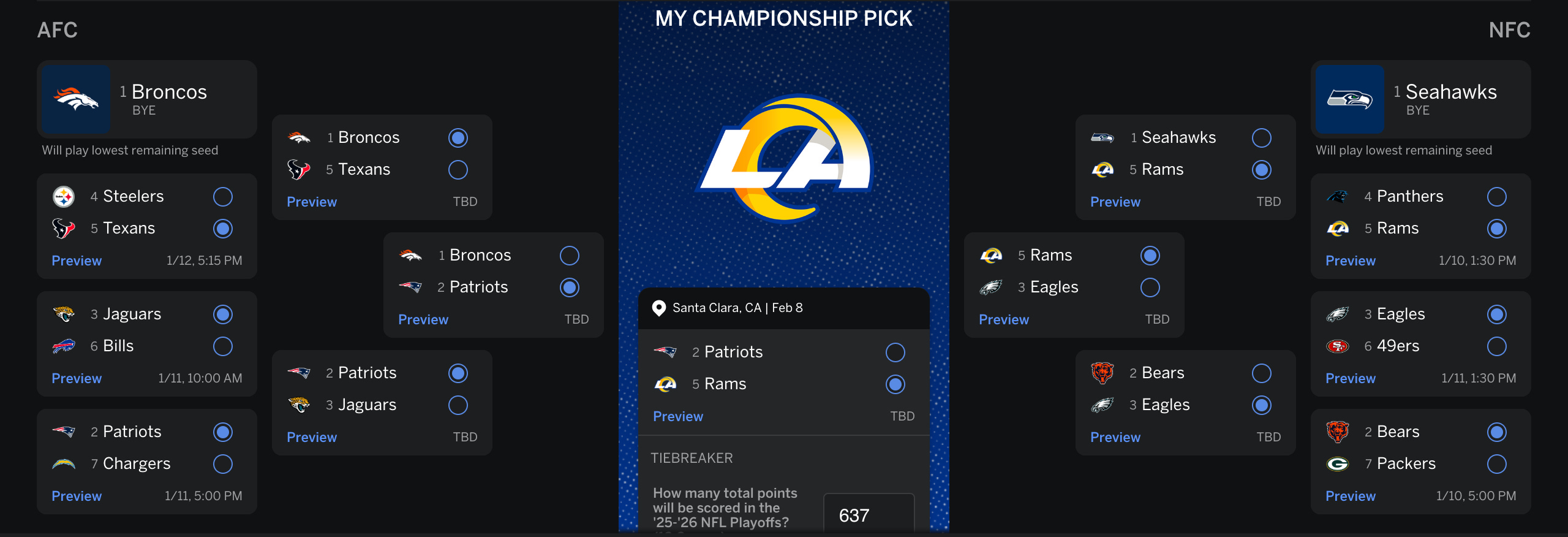
Rams to win 3 straight road games is certainly bold.